



Daisy, Pet Partner with Adam
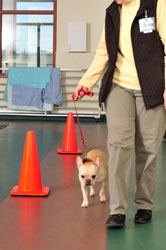 We offer basic and advanced training for interested volunteers and their pets with Pet Partners Team Training and evaluation for Pet Partners registration. A mentor program assists new members to acquire confidence and skills.
We offer a “matching” service for medical, residential, and educational facilities requesting visits from therapy dogs and outreach programs to promote the benefits of animal-assisted interactions.
Dogs On Call, Inc. subscribes to the training and evaluation standards of the Pet Partners, a nationally recognized, non-profit organization. Dogs On Call has several Pet Partners Program licensed instructors and evaluators and Pet Partners registration is a prerequisite for Dogs On Call membership. Read more: Our relationship to Pet Partners.
Dogs On Call, Inc. is governed by an outstanding board of directors, and includes a variety of committees with an active membership of over 90 Pet Partners Teams and growing!
Promoting the Animal-Human Bond and Literacy Through Education, Evaluation, and Participation of Therapy Animal Teams
A Bit of History
 On May 1, 1999, a small group of friends gathered around a kitchen table with one very significant thing in common, a love of dogs.
The questions arose, “Where can we go? What can we do with our beloved four-footed friends? Together, how can we make a difference?”
The answer was simple, the Pet Partners Program, whose motto “Improving Human Health Through Service and Therapy Animals” struck a chord. A group called Dogs On Call was created, and the word spread among more dog lovers wanting to share the talents of their wonderful dogs through the Pet Partners Program.
With our membership growing rapidly, Dogs On Call went on to incorporate in 2004 and in 2008 became a registered 501(c)(3) non-profit and, in addition to our membership with Pet Partners, Dogs On Call became a R.E.A.D. (Reading Education Assistance Dogs) affiliate with Intermountain Therapy Animals.
In September of 2016, Pet Partners added their own Read With Me program that replaces R.E.A.D. for DOC members. Members have the option of joining this reading program after mentoring with DOC’s Reading Program Director.